
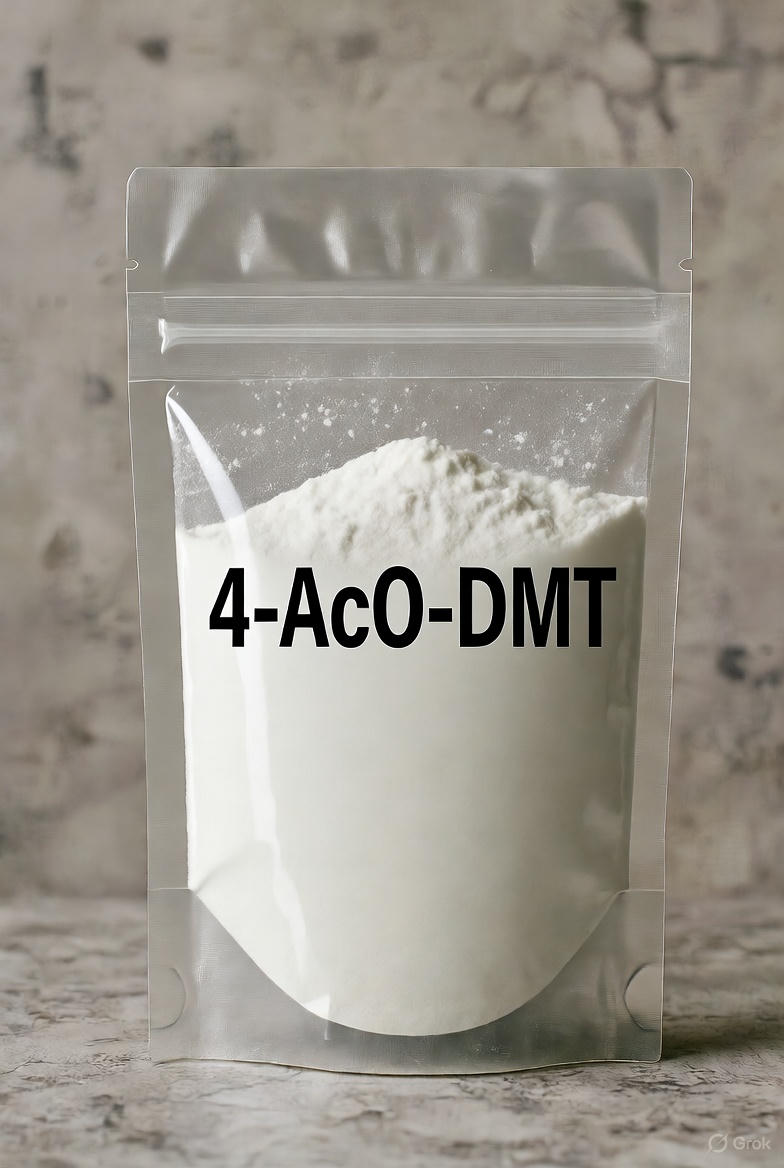
4-AcO DMT
Original price was: $240.00.$199.99Current price is: $199.99.
BUY DMT ONLINE
Why Choose Buy Our 4-AcO-DMT?
Researchers and explorers choose our 4-AcO-DMT because we prioritize pharmaceutical precision over “grey-market” guesswork.
-
Standardized Potency: Unlike organic mushrooms with variable psilocybin levels, our lab-grade powder offers a consistent 1:1 milligram ratio. This eliminates “hot spots” and ensures your research results are repeatable.
-
Reduced Nausea: We remove the chitin and organic plant fats found in raw fungi. By choosing our purified 4-AcO-DMT, you experience a significantly lighter body load and a cleaner onset without gastrointestinal distress.
-
Lab-Verified Purity: Every batch undergoes third-party testing to guarantee 98%+ purity. We ensure our product is free from heavy metals and residual solvents, providing a safety level that street-level “shroom bars” cannot match.
| Feature | Our 4-AcO-DMT | Magic Mushrooms |
| Dosing | Precise (Milligram Scale) | Estimating (Variable) |
| Digestion | Easy / No Nausea | Often Harsh (Chitin) |
| Shelf Life | Years (if stored dark) | Months (degrades quickly) |
| Purity | 98%+ Lab-Verified | Contains organic impurities |
-
Enhanced Stability: Our 4-AcO-DMT is processed as a stable fumarate salt. This means it has a superior shelf life, maintaining its visionary potency for years when stored correctly in a cool, dark place.
4-AcO-DMT
4-AcO-DMT was shelved for several decades until the late 90s when a man by the name of David E. Nichols began campaigning for the use of the substance in psychedelic-assisted psychotherapy. He aimed to motivate researchers to take a closer look at this compound so it could eventually make its way into the medical system. Nichols favored it for its reliability of effects, cost-effectiveness, and sheer potency.
Unfortunately, there has yet to be a single clinical study on the effects of 4-AcO-DMT. Most of the information currently available comes to us from animal studies and anecdotal reports.
Despite how poorly this drug has been studied, 4-AcO-DMT is one of the most popular synthetic psychedelics, falling behind LSD and ketamine but higher than 2C-B, Dipt, or other drugs in the 2C-X family.
It is a whitish brown powder in its raw form, most often sold in capsules or tablets.
4-AcO-DMT vs. Magic Mushrooms: Which is Better for Research?
Many researchers now debate whether 4-AcO-DMT or traditional magic mushrooms provide a superior experience. While both substances metabolize into psilocin, 4-AcO-DMT offers several distinct advantages in a laboratory setting. First, the synthetic version eliminates the “chitin” found in mushroom cell walls, which often causes significant stomach upset and nausea. Furthermore, 4-AcO-DMT provides extreme dosing precision that organic fungi simply cannot match. Because the psilocybin content in mushrooms varies wildly between caps and stems, predicting intensity remains difficult. Conversely, 20mg of pure 4-AcO-DMT delivers a consistent, repeatable result every time. However, some purists prefer the “entourage effect” of secondary alkaloids found in natural mushrooms. Ultimately, if you prioritize a clean physical sensation and mathematical accuracy, 4-AcO-DMT is the clear winner for modern exploration.
Be the first to review “4-AcO DMT”
Related products
Reviews
There are no reviews yet.